


The Nissan Leaf has been at the forefront of the electric vehicle market since its launch more than a decade ago. For 2022, the Leaf comes with even more standard equipment and a lower price tag. Now available from Nissan of Streetsboro, the 2022 Leaf is a stylish hatchback offered in two variants, the Leaf and Leaf Plus, that come with different size electric motors and battery packs.
The standard Leaf comes in S and SV trim levels, while the Leaf Plus is available in S, SV, and SL models. You don’t have to suffer range anxiety when you’re driving the Leaf on the roads of Streetsboro and Cleveland, as it offers a great range on a full charge and multiple charging options to keep you going. Here, we’ll look at the 2022 Nissan Leaf battery range.
Nissan Leaf Battery Range

The 2022 Nissan Leaf S and SV trim levels feature a 110-kilowatt synchronous electric motor powered by a 40-kilowatt-hour lithium-ion battery. This powertrain generates 147 horsepower and 236 pound-feet of torque. These models have an EPA-estimated range of up to 149 miles with a full charge. They return up to 123 miles per gallon equivalent (MPGe) and 99 MPGe on the highway in the city.
The standard Leaf’s range is more than enough for many drivers to cover daily commuting or running errands. From Streetsboro, you could make the return journey to Cleveland or Youngstown twice with range to spare, or a one-way trip to Columbus, Ohio, depending on your driving style.
If you tend to make longer journeys, the Leaf S Plus, SV Plus, and SL plus have a larger 62-kilowatt-hour battery pack and a 160-kilowatt electric motor that delivers 214 horsepower and 250 pound-feet of torque. The S Plus has an EPA-estimated range of up to 226 miles and offers city and highway MPGe of up to 118 and 97, respectively. The SV Plus and SL Plus have additional equipment, meaning more weight, and provide a range of up to 215 miles. You’ll get up to 114 MPGe around town and 94 MPGe for highway driving.
With the Leaf Plus’s range, you could make a round trip from Streetsboro to Pittsburgh, Pennsylvania, or a one-way journey to Detroit. With an ever-growing network of public charging stations, the Nissan Leaf enables you to make longer road trips with no worries about getting stranded with a dead battery.
Optimize Your Battery Range
The actual range you get from your Nissan Leaf is dependent on several factors, including your driving style and the climate. The Leaf offers instant acceleration when you put your foot down for a thrilling driving experience. However, frequent hard acceleration will deplete the battery faster. Smooth driving and gentle use of the accelerator will help the Leaf take you farther.
The Leaf has an Eco mode for gentler driving that maximizes your battery range. You can also take advantage of the Leaf’s e-Pedal that enables you to drive using just the accelerator pedal. You still get the same instantaneous response when you press the pedal, but simply taking your foot off the pedal slows the car down using regenerative braking, which also recharges the battery. Of course, the brake pedal is still there if you need it.
Cold weather tends to drain a battery faster, and you’ll be using the heater, lights, and wipers more often in the Ohio winters. Similarly, constantly using the climate control system will shorten your battery range when the outside temperature rises. With the NissanConnect app on your smartphone, you can set your Leaf’s cabin to the perfect temperature while it’s still charging to avoid depleting the battery.
Charging Options
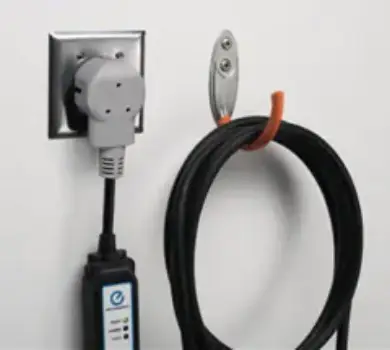
The Nissan Leaf offers you three ways to charge the battery, whether you’re at home or out on the road. All Leaf models come standard with a 6.6-kilowatt on-board charger and a portable charging cable for use with 120-volt and 240-volt power outlets. The S and SV trim levels also have a 50-kilowatt quick charge port, while the Leaf Plus models feature a 100-kilowatt high output quick charge port.
The quickest way to charge your Nissan Leaf is at a public 480-volt DC quick charging station. The Leaf uses a CHAdeMO connector for fast charging, so you’ll need a station with that specific type of connector. Nissan partners with EVgo, which has the country’s largest network of public fast chargers. All EVgo fast-charging stations offer CHAdeMO connectors.
At a fast-charging station, a 50-kilowatt quick charge will take around 40 minutes to give a 40-kilowatt-hour battery an 80% charge. Charging a 62-kilowatt-hour battery to 80% capacity will take 45 minutes with a 100-kilowatt quick charge or 60 minutes with a 50-kilowatt quick charge.
You can use a Level 2 charger and your Leaf’s portable charging cable to charge at home or on the go. There are many public Level 2 chargers, and you can have a Level 2 wall-mounted charging station installed at your home. These chargers feature a 240-volt outlet, and you plug in your charging cable. It will take around eight hours to fully charge a 40-kilowatt-hour battery and 11.5 hours for a 62-kilowatt-hour battery.
Level 1 charging uses a standard household 120-volt power outlet and your portable charging cable. Level 1 is the slowest charging option, but it’s helpful if you want to add a little top-up to your battery charge while your car is parked with access to an outlet.
Whichever charging method you use, charging your Nissan Leaf is simple. You park at the charging point and ensure the vehicle is turned off. Open the charge port lid and connector cap and plug in the charge connector. The car gives a quick beep to let you know it’s connected correctly. When the battery is fully charged, the car stops charging automatically, or you can stop charging any time by simply unplugging the charge connector.
Drivers in Ohio can check out the 2022 Nissan Leaf at Nissan of Streetsboro. Contact us today to schedule a test drive and see how far the Nissan Leaf can take you.
Connect with us


